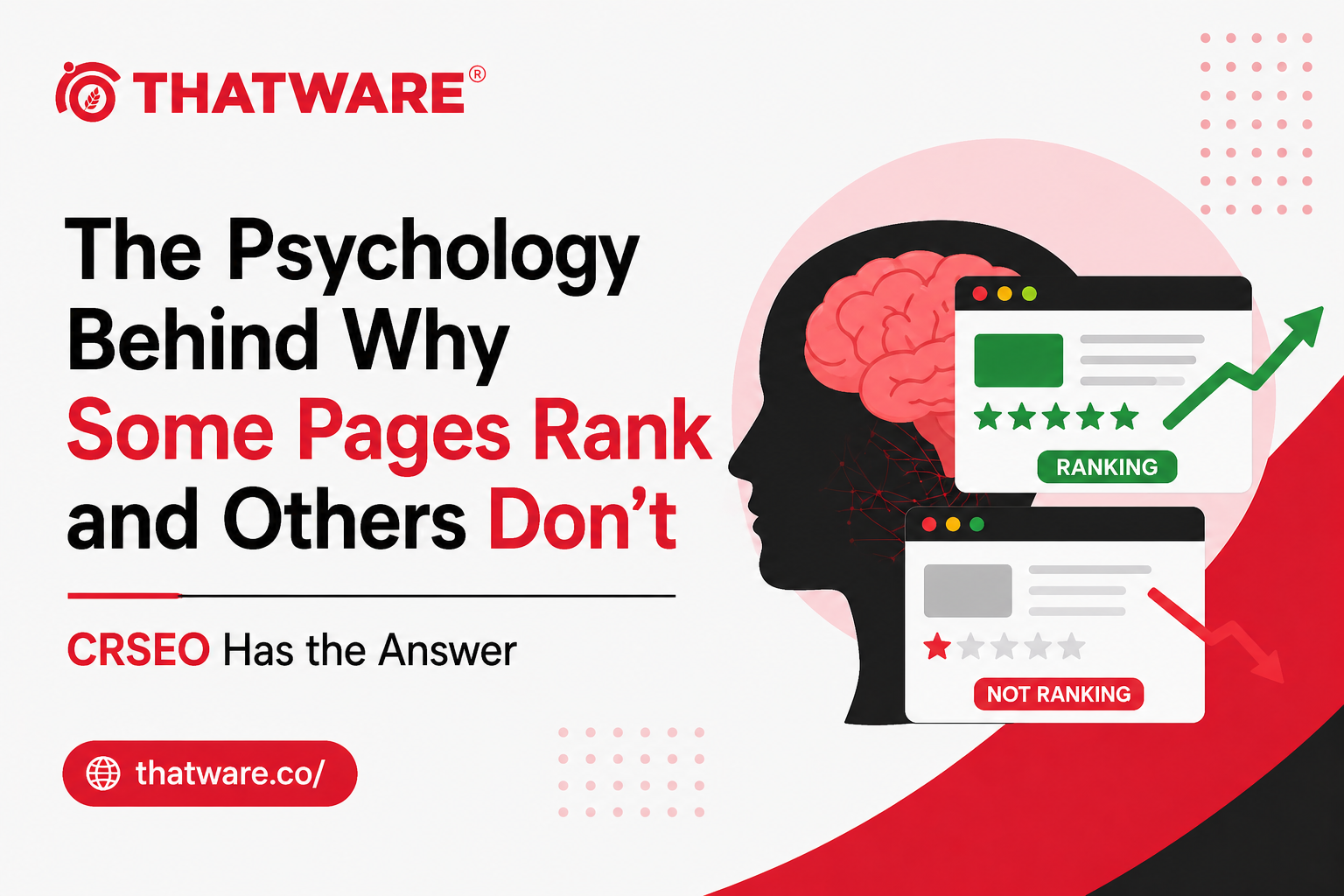
Two pages. Same keyword target. Similar domain authority. Similar technical SEO health. One ranks consistently in the top three positions. The other floats between positions eight and fifteen and can’t seem to break through despite ongoing optimization work.
This scenario is familiar to anyone who has spent serious time in SEO. And the standard toolkit runs out of answers relatively quickly when the obvious technical and authority factors are roughly equal. The page that ranks is doing something the other isn’t, and it’s often something that standard auditing tools don’t measure.
Cognitive Resonance SEO is built around identifying that something. The thesis is that content performance in search is not fully explained by technical factors and authority signals. There’s a dimension of how content resonates with human cognition, how well it matches the mental model of the searcher, how satisfying it is to encounter and engage with, that search engines have become increasingly capable of detecting and rewarding.
Understanding this dimension produces insights that traditional SEO auditing misses.
What Cognitive Resonance Actually Means
Cognitive resonance in content occurs when the content meets the reader at their level of knowledge, addresses their actual concerns in the order they naturally arise, and provides information in a structure that feels intuitive rather than arbitrary.
This sounds like good writing advice, and it is. But it’s also increasingly an SEO factor because the behavioral signals that search engines use as quality feedback, how long people stay on a page, whether they return to the search results immediately, whether the page satisfies their intent or leaves them searching again, are measuring cognitive resonance whether or not the algorithm designers use that term.
Content that resonates cognitively keeps people on page. Content that doesn’t causes them to bounce back to the SERP. These signals feed into ranking evaluation in ways that affect long-term position in ways that technical optimization can’t compensate for.
Crseo services analyze content through this lens, identifying not just whether it’s technically well-optimized but whether it’s structured in a way that genuinely serves the cognitive needs of the searcher.
The Mental Model Alignment Problem
Every searcher brings a mental model to a query. They have a level of existing knowledge, a set of assumptions, a specific aspect of the topic they’re trying to understand. Content that aligns with this mental model is experienced as helpful. Content that doesn’t is experienced as frustrating, even if it’s technically accurate and comprehensive.
The mental model alignment problem is particularly visible in technical and expert content. An article about a complex topic written for an expert audience lands poorly with intermediate-level searchers who are the actual majority of query volume. An article written for beginners fails to satisfy the expert who’s looking for depth.
Most content doesn’t clearly identify who it’s for and calibrates accordingly. It exists at an implicit level of assumed knowledge that may or may not match the actual searcher population. When there’s a mismatch, the behavioral signals suffer and rankings reflect that over time.
Auditing content for mental model alignment, and making explicit decisions about which audience a page serves and calibrating depth and assumed knowledge accordingly, is part of what CRSEO practitioners do.
The Content Satisfaction Framework
Cognitive search optimization uses a framework for evaluating whether content actually satisfies the implicit request behind a search query, beyond just matching the explicit keyword.
Every search query contains an explicit component, the words the person typed, and an implicit component, what they actually want to accomplish or understand. “Best CRM for small business” is explicitly a comparison request. Implicitly, it’s probably a request from someone who is overwhelmed by options and wants help making a decision, not just a list of features.
Content that answers the explicit query but ignores the implicit need produces a worse user experience than content that addresses both. The person gets a feature comparison table, feels no clearer about what to choose, and goes back to search. The behavioral signal is negative.
Content that understands the implicit need, that acknowledges the difficulty of the decision, provides a decision framework alongside the feature comparison, and helps the searcher feel oriented rather than more confused, produces a genuinely satisfying experience. The person gets what they needed. They stay. They may return. The behavioral signal is positive.
Why This Explains the Ranking Gap
Returning to the two-page scenario at the start. When both pages have similar technical health and authority signals, the explanation for consistent performance differences is often in this cognitive resonance dimension.
The page that consistently ranks higher is usually the one that better satisfies the implicit need behind the query, that aligns better with the mental model of the majority of searchers, that produces more consistently positive behavioral signals over time.
These signals are difficult to measure directly but are visible in aggregate. Pages with strong cognitive resonance tend to have lower bounce rates, higher average session durations, and better query satisfaction metrics than pages that are technically optimized but cognitively misaligned.
Identifying these patterns and improving content accordingly is the practical work of CRSEO. The outcome, better behavioral signals that improve ranking stability and position, is measurable even when the underlying mechanism is more psychological than technical.
The Longer Game
Cognitive resonance is not a quick win. Unlike fixing a technical error, improving how well content resonates with human cognition requires understanding your audience more deeply, revising content with that understanding in mind, and waiting for the improved behavioral signals to feed into ranking evaluation.
But it’s a more durable improvement than technical fixes, which can be replicated by competitors. Content that genuinely resonates with a specific audience in a way that’s built on real understanding of that audience’s needs is harder to copy than a meta tag or a page speed optimization.
The pages that rank consistently at the top of competitive SERPs, year after year across algorithm updates, are typically the ones with the strongest cognitive resonance alongside their technical and authority foundations. Building that resonance is the long-game SEO investment that compounds most reliably.