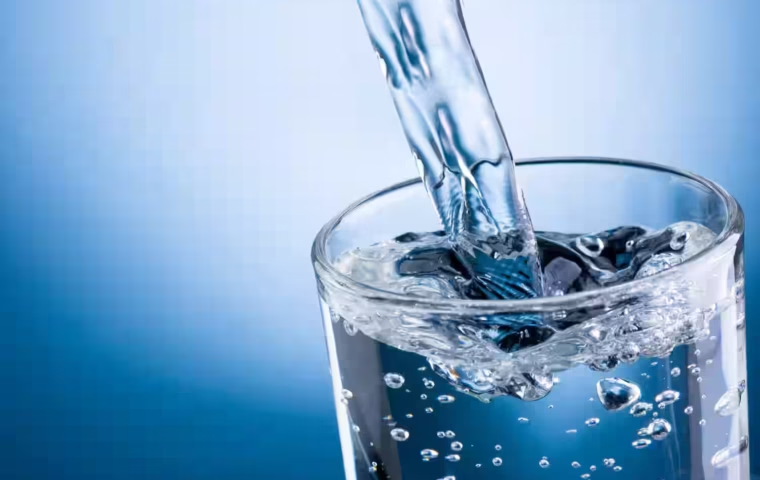
Most of us don’t think twice about water. You turn the tap, fill a glass, and move on with your day. It’s one of those everyday comforts—reliable, familiar, almost invisible in how it supports your routine.
But every now and then, a question sneaks in. Maybe it’s triggered by a news story, or a slight change in taste, or just curiosity. You pause and wonder… what’s actually in this water?
It’s not a dramatic question, but it’s an important one.
The Things You Can’t See
Water is deceptive in that way. It can look perfectly clear and still carry elements you’d never notice on your own.
Some of those elements are completely natural—minerals picked up as water travels through soil and rock. Others can come from infrastructure, environmental factors, or even household plumbing.
Among these are metals and heavy metals, which can find their way into water through corrosion or natural deposits. In small amounts, some metals are harmless. But at higher levels, they can affect taste, safety, and long-term health.
The tricky part? You won’t always know they’re there. No obvious color, no strong odor. Just a quiet presence that requires proper testing to detect.
When Water Carries More Than Just Minerals
Beyond metals, there’s another layer to consider—living organisms.
It sounds unsettling, but it’s part of the natural world. Water can sometimes carry microorganisms, especially in systems that aren’t regularly treated or maintained.
This is where bacteria and microbial concerns come into focus. In most treated municipal supplies, these risks are carefully managed. But in certain situations—like private wells or aging systems—they can become more relevant.
Again, the challenge is that you can’t rely on your senses alone. Water might look and taste fine, even when something is present.
That’s why awareness matters. Not in a way that creates fear, but in a way that encourages understanding.
The Chemicals You Didn’t Expect
Then there are the substances that sound a bit more technical—compounds that don’t naturally belong in water but can end up there through industrial processes or environmental exposure.
One example is volatile organic compounds, often referred to as VOCs. These can come from a variety of sources, including manufacturing, fuel, and even household products.
In most cases, levels are low and regulated. But like everything else, it depends on your specific environment.
The idea isn’t to assume the worst. It’s simply to recognize that water, while essential and generally safe, isn’t always as simple as it seems.
Why This Matters in Everyday Life
At first glance, all of this might sound a bit overwhelming. Metals, bacteria, compounds—it’s a lot to take in.
But the impact is often more subtle than dramatic.
Water quality can influence how your home functions. It affects taste, of course, but also how appliances perform, how your skin feels after a shower, even how long fixtures last.
These are small things, but they add up.
And once you start noticing them, it’s hard to ignore the role water plays in your daily life.
Turning Curiosity Into Clarity
The good news is, you don’t have to guess.
If you’re curious—or if something feels off—testing your water is a straightforward way to get answers. Not assumptions, not general advice, but actual information about your specific situation.
From there, everything becomes clearer. You can see what’s present, understand what it means, and decide if any action is needed.
Sometimes, the result is reassurance. Everything is within normal ranges, and you can move on without worry.
Other times, it highlights areas for improvement. And even then, solutions are often simpler than you might expect.
Keeping It Practical
It’s easy to overcomplicate water quality. To think it requires major changes or expensive systems.
But often, it starts with small steps. Awareness. Testing. Understanding.
You don’t need to fix everything at once. You just need to know what you’re dealing with.
And once you do, you can make decisions that fit your home, your preferences, and your comfort level.
The Quiet Impact of Better Water
What’s interesting about improving water quality is how quietly it changes things.
There’s no big moment where everything feels different. Instead, it’s gradual. Water tastes a bit cleaner. Appliances run more smoothly. Daily routines feel a little easier.
And over time, those small improvements become your new normal.
Final Thoughts
Water is one of the most constant elements in our lives. It’s always there, always flowing, always part of what we do.
But taking a moment to understand it—to ask what’s really in it—can make a meaningful difference.
Not in a dramatic way, but in the quiet, everyday sense that things are working as they should.
And sometimes, that’s all we’re really looking for.